

Dr. John Grabowski, together with his wife, Claire, helped prepare us for marriage way back 25 years ago this month. So, we were honored to have the opportunity to interview him about his new book A Catholic Guide to Being Human. We hope you’ll enjoy the resulting conversation about what it means to live an authentically human—and authentically Catholic—life!
From the quiet formation he received under his mentor, the late Fr. Francis Martin, to the everyday obstacles of scientism, technology, and distraction, Dr. Grabowski offers both a rich theological vision and simple, practical steps for families seeking deeper connection. Read on for his reflections on identity, dignity, and the family as a communion of persons.
We love how you dedicated the book to Fr. Francis Martin. He has a special place in our hearts, given that he celebrated our wedding Mass 25 years ago this summer. Can you share why you dedicated the book to him?
Grabowski: My wife and I were blessed to have Fr. Francis as a professor and priest during our undergraduate years at the Franciscan University of Steubenville. He went on to be a close family friend, baptizing two of our children, and was a frequent guest at our dinner table.
As undergraduates, Fr. Francis taught us how to have a daily prayer time and listen for the Lord’s voice. In the classroom, he taught us how to read Scripture as the Word of God and to encounter the Lord in its pages. For a young aspiring theologian, it was a profoundly formative experience.
What inspired you to write A Catholic Guide to Being Human — and who did you have in mind as you were writing it?
Grabowski: Our Sunday Visitor approached me and asked me to write it. They wanted a book on Christian anthropology for ordinary Catholics—people without a lot of background in philosophy of theology. I had taught a course on Christian anthropology for men studying for the permanent diaconate and their wives for many years, so I took much of that material from the course and put it into the book.
What are the two or three most important takeaways you hope readers will put into practice in their own lives and relationships?
Grabowski: The first takeaway is that we can only fully understand ourselves in the light of Jesus Christ. The Second Vatican Council taught: “Christ, the final Adam, by the revelation of the mystery of the Father and His love, fully reveals man to man himself and makes his supreme calling clear” (Gaudium et spes, no. 22).
The second takeaway is that our dignity as human beings does not come from anything we do and it cannot be taken away by anyone else. It comes from the fact that we are made by God, loved by Him, offered redemption in Christ, and called to an eternal destiny.
The third takeaway is that science and technology are meant to serve us—not save us. Only God and His love can do that.
As you look at the culture today, what do you see as the three biggest obstacles to people living out an authentically human—and authentically Catholic—vision of what it means to be human?
Grabowski: One major obstacle is Scientism—the belief that science holds the answers to everything, including questions about who we are, why we exist, and how we can find happiness.
A second obstacle is the Transhumanism—the impulse to try to remake our nature as human beings. We can see this not only in the effort to cheat or overcome death through technology but in much more common practices like contraception.
A third obstacle that is perhaps the most widespread, affecting most of us in varying degrees, is our habit of replacing real human connections with technological buffers (think screens) or substitutes (think AI bots as companions, life coaches, etc.).
These obstacles can feel overwhelming for busy families. What gives you hope that ordinary people—including families navigating a very difficult cultural moment—can live in an authentically human way?
Grabowski: Ultimately, Christian hope has one source and one aim—“the God of hope” (Rom. 15:13). The more we make Him the center of our life as families, the more genuinely human we can become in the way we relate to each other. And the less likely we are to get distracted or seduced by the cultural counterfeits around us.
Looking back, was there a turning point in your own life as husband, father, and scholar when the content of A Catholic Guide to Being Human really became personal for you—a moment when the theology stopped being academic and became something you lived?
Grabowski: I can think of many examples over the years. As technology found its way into our home we had to (and still have to) work to limit its reach. This meant that when our kids were teenagers we had to enforce a no phones at the dinner table so that it could be a time of conversation and connection without distraction.
Now that we are grandparents, we try to model undistracted presence to our grandchildren by not having phones out around them. In this way we try to show our grandchildren (and their parents) the importance of real human connection.
At Trinity House, we speak of the family as a “communion of persons,” drawing on Catechism 2205: “The Christian family is a communion of persons, a sign and image of the communion of the Father and the Son in the Holy Spirit.” How do you see the themes of A Catholic Guide to Being Human connecting to this vision of the family as a reflection of Trinitarian life?
Grabowski: One of the things the book traces is how the very concept of “person” comes to us through the Church’s effort to understand and express the mystery of the Trinity. At the heart of this mystery is relation: the Father begets and is not begotten; the Son is begotten by the Father in an eternal act of generative love; the Holy Spirit is breathed forth by both as their mutual gift of love to one another.
To be a human person is also to exist in relation—to God and to one another. Our task as human and Christian is to actualize these relations in relationships of love and communion. Our families are the first place where we learn this and put it into practice.
For someone who feels like they’re just trying to survive—keeping up with work, kids, and daily life—and wonders whether this vision of “being fully human” is even realistic, what is one small, practical first step you’d encourage them to take this week?
Grabowski: I would encourage people to look for ways to limit their time on screens and to use this time to increase the time they give to prayer and conversation with family and friends.

➤ In the “What Does It Mean to Be Human?” interview with Dr. Marcus Peter, Dr. John Grabowski presents the central themes of his book A Catholic Guide to Being Human. The conversation explores how the Christian understanding of the human person provides a coherent response to many of today’s cultural and technological questions.
➤ This article provides Catholic commentary arguing that innovation should always remain ordered to the common good and the dignity of the person. (Trenton Monitor)
➤ This article provides an accessible introduction to Catholic anthropology, exploring the human person as a unity of body and soul, created in God’s image and called to live with dignity and purpose. (Word on Fire)
➤ According to the Catechism of the Catholic Church, paragraphs 355–421, the human person is created in God’s image, embodying a unity of body and soul, and possesses inherent dignity, though tainted by original sin.

 |
➤ Are you a parent, priest, director of religious education, or principal interested in building community among families at your parish or parish school? Discover all the details here, and easily schedule a quick 15-minute discovery call with our team here. Dioceses can benefit from a special offer: three subscriptions for just $999 (or $499/year for your parish). Take the first step toward strengthening community among families at your parish right here!

➤ For those in the Washington, DC area, registration for the conference Together in Holiness is now open! Soren will be giving one of the talks. Engaged and married couples are invited to visit togetherinholiness.org/washington to learn more and register.
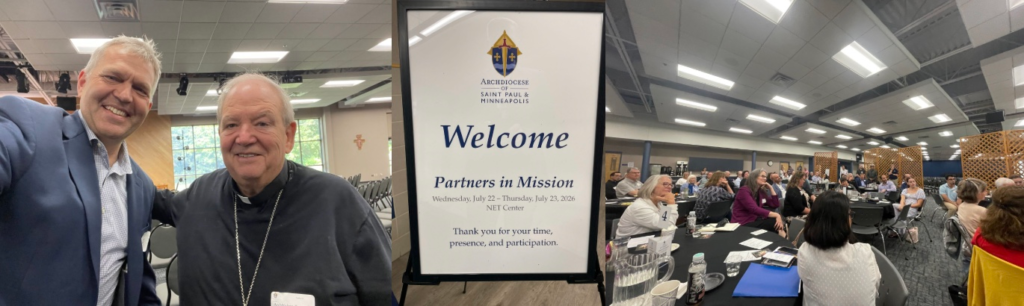
➤ Soren enjoyed meeting Archbishop Hebda and numerous apostolate and parish leaders at last week’s Partners in Mission gathering, hosted by the Archdiocese of Saint Paul & Minneapolis’ Office of Discipleship and Evangelization. Attended by nearly 100 leaders including Jason Simon of Evangelical Catholic and Brock Martin of FOCUS, the gathering included times of prayer, worship, and discussion of how to advance pastoral goals that are close to the heart of the Trinity House Community Groups: parents as primary educators, reclaiming Sunday, accompanying families, and the importance of small groups in forming and sending missionary disciples.
➤ The Poplar & Prose Journal — based in Ashburn, VA, featured “5 Questions” with Soren in their current issue. The series features favorite books, daily rituals, and ordinary moments.
➤ We’re hiring! For Heaven in Your Home readers within driving distance of Leesburg, VA, Trinity House Cafe + Market is hiring. We’re looking for a part-time barista (10–20 hours/week) to join the Trinity House Cafe + Market team! If you enjoy serving others, creating a welcoming atmosphere, and being part of a ministry of hospitality, we’d love to hear from you. Learn more and apply here.
➤ Will you join us? There’s still time to give to our mid-year appeal! The growing impact of Trinity House Community is made possible entirely by supporters. Will you prayerfully consider partnering with Trinity House today through a monthly gift of $10, $20, or more — or with a one-time gift of $20, $50, $100, $250 or more? Your mid-year gift will be doubled, thanks to generous supporters. Thank you for investing in the renewal of the family!
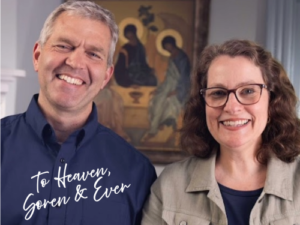
“We have been more intentional about times of prayer together as a family, which has helped us to understand our teens’ needs and concerns, since they open up during this time. That is such a blessing.”
— Jodi, Trinity House Community Participant