


Try to imagine this for a moment.
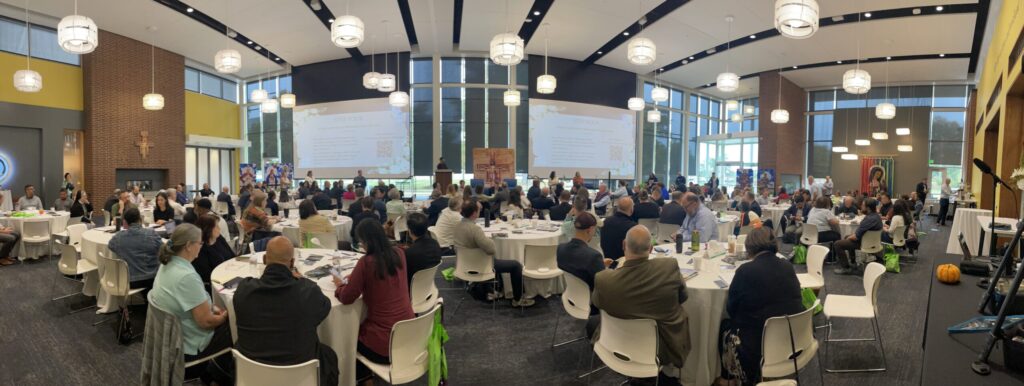
You put 100 apostolate leaders in a room with about 100 diocesan evangelization directors from across the country. Add 7 bishops. You don’t dazzle them with keynotes—in fact, there are none. You don’t offer them an array of practical workshops and breakout sessions on all the hot topics. You don’t hand out a single award. You don’t show a single video. You don’t have a single exhibitor table.
Instead, you bookend each day with Mass and evening prayer or Adoration. And in between you assign them to tables and give them five 2-hour sessions to share and discuss the fruits of their prayer, their efforts to share the faith, and how the Church should respond to the challenges of today. At each table, you place a trained facilitator to keep the conversations focused on a series of penetrating questions.
The setting? Instead of a bland hotel in conference-land, this all happens at Marian University, a vibrant and growing Catholic college in Indianapolis. You place these leaders in the heart of a bustling campus, constantly bumping into members of the next generation—on whom you are reflecting at the tables. Instead of having Mass in a hotel ballroom, you worship in a beautiful and reverent chapel, and the talented university choir accompanies each Mass.
In the month leading up to the synodal-type conversations at the tables, you don’t market to these leaders. All you do is compile a reader with selected excerpts from Scripture, Vatican II (e.g., Lumen Gentium), and the writings of Pope Leo and the popes since Vatican II, and you ask them to read and reflect (the reader will soon be available online at the USCCB here).
This is the quite different and altogether refreshing format that we experienced firsthand last week at the U.S. Conference of Catholic Bishop’s first-ever Evangelization Summit, Oct. 13-15, “Witnessing to the Light of Christ—The Way, the Truth, and the Life,” hosted by their Committee on Evangelization and Catechesis.
David Spesia, executive director for the USCCB’s Secretariat for Evangelization and Catechesis, shared: “We were inspired in part by Pope Leo’s message for World Mission Sunday, particularly his closing prayer — ‘Holy Father, make us one in Christ, rooted in his love that unites and renews. May all members of the Church be united in mission, docile to the Holy Spirit, courageous in bearing witness to the Gospel, proclaiming and daily embodying your faithful love for all creatures.'”
To put you into the room with us—the laughter, tears, silences, and deep moments of encounter—we’re happy to share some brief but powerful takeaways in the form of quotes from those who reported summaries of their table discussions.
As a practical next step, we’d like to encourage you to bring them to an upcoming time of prayer; invite the Holy Spirit into the moment; and ask the Lord to renew your missionary discipleship and zeal for forming your family to share His life with others:
- “A loving Christian is the first gospel that many people hear.”
- A prayer: “Lord, let today not be the day that I become just another church worker.”
- “Evangelization happens at the pace of relationships, of friendship.”
- “If you look at Jesus, He was actually by our U.S. standards horribly inefficient.”
- “Prayer is the foundation of ministry, not another task alongside it. Plan your day, your week, your month, around your prayer schedule. Put those things first.”
- “Any Holy Spirit moment cannot be manufactured. It has to be surrendered.”
- “Become the thermostat… bring Jesus into the room… And so change the temperature of the room. Be bold.”
- “Accompaniment is not a program. It’s an introduction to the person of Jesus Christ. It is ‘come and see God,’ not ‘come and see the programs that we offer.’ Accompaniment has a destination: it’s heaven.”
- “People are not our projects. We can’t see others as people whose lives we need to fix. We need to listen without having an agenda. We need to promote a relational encounter rather than a transactional one.”
- “The Church isn’t the only field hospital. The home is also a field hospital, and the operating table is the dining room table.”
- “Before we can become missionary disciples, we have to be disciples. It’s really comfortable to be a disciple, and it’s really uncomfortable to become a missionary disciple.”
- “Missionary discipleship is imparted more than it is taught. You’ve got to rub shoulders with people who are doing the work.”
- “Are we just sacramentalized? Or are we first evangelized?”
- “We’re arguably in the midst of a spiritual revival among young adults… Are they seen by us, or are they just slipping in and out?”
- “We need to be ready to receive the wave we can all see coming to our ecclesial shore.”
- “The encounter with the Lord is never just ‘one and done.’”
- “Are we trying to establish KPIs and ROIs, using 21st century metrics for what Jesus taught us as biblical evangelization? It’s really hard for us to gauge the conversion of someone’s heart, which is where the real fruit takes place.”
- “We can smile at people when they come into the church, and that’s not friendship. That’s ‘invulnerable politeness.’ Friendship is something like inviting someone over for coffee.”
- “Accompaniment is messy. Accompaniment requires compassion, the willingness to suffer with others. It always includes the cross.”
- “Faith is spelled R I S K.”
With so many amazing insights shared, what was our #1 takeaway from the Evangelization Summit? It wasn’t a new method, a new program, a new series of steps. Over and over, we were reminded of this: if we desire to be His missionary disciples, we must accept Jesus’ invitation to a deeper life of prayer. More time with Him. More time receiving His unconditional love. We can’t give what we don’t have. He is waiting to renew us—to give us a new experience of His unconditional love. And yes, to send us forth to make new disciples.
➤ At the Evangelization Summit, Pope Leo XIV’s 2026 World Mission Day message — “One in Christ, United in Mission” — served as the jumping off point.
➤ Living as Missionary Disciples: A Resource for Evangelization (pdf), published by the USCCB’s Committee on Evangelization and Catechesis, remains a key reference point for the Church in the United States.
➤ The USCCB’s Committee on Evangelization and Catechesis home page includes a wealth of resources on evangelization, catechesis, OCIA, the Eucharistic Revival, and more.

➤ Are you a parent, priest, director of religious education, or principal interested in building community among families at your parish or parish school? Discover all the details here, and easily schedule a 15-minute discovery call with our team here. Dioceses can benefit from a special offer: three subscriptions for just $999 (or $499/year for your parish). Take the first step toward strengthening community among families at your parish right here!
➤ We’re hiring at Trinity House Cafe + Market! For Heaven in Your Home readers within driving distance of Leesburg, VA, we’re looking for a part-time barista (10–20 hours/week) to join the Trinity House Cafe + Market team! If you enjoy serving others, creating a welcoming atmosphere, and being part of a ministry of hospitality, we’d love to hear from you. Learn more and apply here.
➤ For Heaven in Your Home readers in northern Virginia: Come and see the St. Jerome Institute (SJI) of Northern Virginia! As a new high school at the St. Philip Catholic Church campus in Falls Church, SJI aims to cultivate friendship, joy, and wonder through seminar-style classrooms, an integrated Catholic curriculum, and low-tech learning. Bring your questions to the Open House on November 14th, 3-5pm and enjoy refreshments, a seminar demonstration for parents, and a seminar sample for students! RSVP to the Open House here.
➤ For those in the Washington, DC area, registration for the Nov. 14th conference Together in Holiness is open! Soren will be giving one of the talks. Engaged and married couples are invited to visit togetherinholiness.org/washington to learn more and register.
“A positive change I’m seeing in my family as a result of Trinity House Gatherings is that my husband has taken charge of managing the children’s weekly chores, something that hadn’t been implemented before.”
— Madelene, Trinity House Community Participant