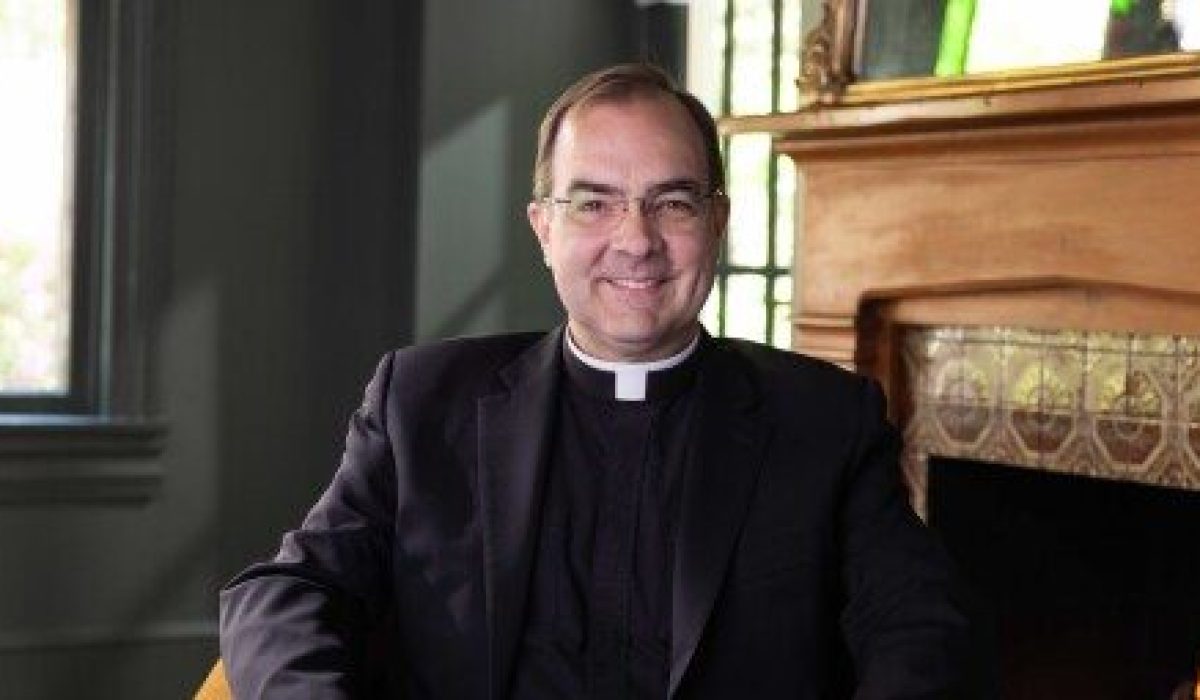

This week, we had the opportunity to interview Father Carter Griffin, a close priest friend and the rector of Saint John Paul II Seminary in Washington D.C. Father Carter recently published an incredible book called Forming Families, Forming Saints which offers practical and pastoral guidance for families in today’s culture. We know that the interview below is lengthy…but we also know that you will be blessed by Fr. Carter’s wisdom and practical insights! If you would like your own copy of Father Carter’s transformational book, you can find it here. We hope you enjoy Father Carter’s insights as much as we did!
You can view a PDF version of the following interview here. Here’s an idea for your consideration: hit “print” on the PDF and read this interview in one of your upcoming times of prayer and devotion. Invite the Holy Spirit to guide you.
Forming Families, Forming Saints is a beautiful and inspiring book that we commend to all families. You are a busy rector of a seminary…can you tell us what led you to carve out the time to bring this book to life?
The book emerged from lots of conversations with parents raising children. There is an awful lot hitting families today – an increasingly secular culture that becomes ever more separated from its Christian roots, progressive ideologies that have little patience for Christian morality, dramatic changes in technology, a lack of community support for families and children, and so on. We are dealing with all those things in the seminary too, but doing so with the long experience and wisdom of the Church behind us and guiding us. It therefore seemed a natural jump to apply some of that experience and wisdom to family life.
Also, the family is sometimes called the “domestic church” because that is ordinarily where disciples of Christ are generated, formed, and sent out on mission. Since the seminary has the same aims, though in the context of priesthood, there is bound to be a lot of overlap in the means of formation. The way we do formation in the seminary, with a very intentional and methodical approach, is a helpful approach for parents too.
Like the rest of us, parents can get caught up in the urgency of the present moment and can lose sight of the bigger picture. Stepping back and looking at the formation of children more broadly, trying to fill gaps where needed, seems to me a worthwhile effort for parents, as it is for us seminary formators in our work of forming future priests.
Can you share one or two particular moments in your own upbringing that you return to regularly, that gave you parts of the formation you write about in Forming Families?
Sure. When I was growing up my family moved a lot, and we tended to be very close. At 16, I went off to boarding school in another country and was, to put it bluntly, miserable. I was terribly homesick. By November, I had had enough. I got into one of those old phone booths and called my parents, letting them know that I was giving up, that I wanted to come home and finish high school there.
At that moment, what I needed to hear from my mother was that I was always welcome home, no matter what. That’s exactly what she said, and I am forever grateful for it. What I needed to hear from my father, however, which was the last thing I wanted to hear, was that I needed to stick it out and finish the year. So I didn’t go home, and it ended up being one of the most difficult, most formative, and truth be told, best periods of my life.
It was the combination of mercy and truth that I needed, and that my parents so often provided, which has informed much of my life and my priesthood. Incidentally, in that case it was my mother who exemplified mercy and my father the demanding voice of reason, but it was sometimes the other way around!
Another formative moment for me was when my parents adopted my sister from an orphanage in Lima, Peru, where we were living at the time. We had been living in Latin America for a number of years and had witnessed a great deal of poverty in those beautiful countries. Adopting Cameron was one way that they could make a difference in at least one life.
I was edified by the great efforts they made to adopt her and to make a new home for her. She has been a blessing to us all. My parents’ naturalness and generosity, reflected in Cammie’s adoption, have always been a great witness to me. Their example informs many of the pages of Forming Families, Forming Saints.
Before becoming a priest, you spent a number of years as a Naval Officer serving on a destroyer and a cruiser in the Atlantic Fleet. Are there any lessons from your military training that you drew from as you wrote about the formation of the family in Forming Families?
The Navy was very formative. The training and experience I received helped me grow in many practical ways; it taught me order and organization, leadership lessons, and perseverance in the midst of obstacles. Engaging in inspections and drills as well as real-world threats in the Persian Gulf taught me to remain calm in stressful conditions. I had a tighter bond with my shipmates, on a common mission, than I had ever experienced before. All these translated to lessons for civilian life as well.
More than skills, however, I feel that I received as a young Naval Officer an apprenticeship in servant leadership and even fatherhood. When I was a young division officer, for instance, I found myself responsible for over 30 men in my division, some of them twice my age. Many of those men, believe it or not, looked to me for advice even in their personal lives. I had to extract sailors from more than one scrape!
What I learned, as every parent also learns, is that I did not always feel up to the task. In fact, I was not up to the task, but I was the guy on the spot. Those men looked to me, and I had to do my best to serve them. It impressed on me just how important such leadership is, how fruitful it can be in the lives of others, and above all, how sometimes we just bring our poverty to it and God takes care of the rest. It was, as I say, truly an apprenticeship for priesthood! Those lessons are just as relevant, I think, for parents.
It’s a big question, but for families caught in the treadmill of busy and who are “over-indexing” sports and other extracurriculars – yes, all of them “good” but nonetheless time-consuming – and “under-indexing” the deep formation of their children through the Sabbath, sacraments, family prayer, dinner time, family culture, and quality time together, where should they start? What’s a good first step to get off the treadmill?
I don’t know any other way to say this. To get off the treadmill, you just have to get off the treadmill. I don’t mean to sound glib, but that’s the truth. There are no silver bullets. We have to start by intending, really intending, to live a fuller, more balanced, richer life. When both parents are committed to that, something really beautiful can happen. But we cannot be passive. It will take an effort.
The next step is to take stock. Do an inventory of your family life, perhaps using the four pillars – human, spiritual, intellectual, apostolic – that make up the outline of formation. Ask yourselves what is going well, what could be done better, and where a gap needs filling. Here is one way this can be done. Parents, find a weekend to get away for an overnight “retreat”. Ask someone to watch the children. In order to take a snapshot of your family’s progress, spend a bit of time in prayer and then slowly, methodically, go through a typical week, maybe a typical month, in your family:
What takes up your time and that of your children? What is the environment like? Are people able to be sincere with each other? Why or why not? What are you happy about? What are you not happy about? Consider how the children – and you – are doing humanly, spiritually, intellectually, and in making friends and sharing the faith. Identify the biggest gaps and figure out some practical ways to grow.
Then come up with a list of priorities for the family as a whole and for each member of the family. Priorities will suggest where time should be spent. Sometimes the best thing to do, and probably the hardest thing to do, is to cut out good activities that do not fit into a balanced plan of life. There should be room for genuine leisure. Look especially at how recreation is used, and figure out ways to minimize screen usage.
See how an open, sincere, transparent environment can be better fostered. Make sure that the spiritual lives of every member of the family are being actively promoted. Consider how your family can be more outwardly focused on the needs of others. Identify ways that the family can come together intentionally, ideally daily, for a meaningful and human sharing of experiences. Make a plan that is realistic and concrete. What will stay the same, what can be improved, what has to be removed, and what needs to be added?
After brainstorming, have a nice dinner together and reminisce on your courtship and on all the experiences, good and difficult, that have shaped your marriage and your family. Give thanks to God for all of it. The next morning, go through your “family plan” again before returning home. Consider doing this once a year. Twice a year is even better.
The key thing is consistency and growth. It won’t all happen at once. Commit to one or two goals in each area of formation, or perhaps for each child in each are of formation, and practical ways to make headway. Set up a monthly meeting to review progress, first just between the parents but eventually inviting older children into that discussion. Keep it upbeat, positive, and joyful. What you are aiming for is a thriving life for each parent, each child, and the family as a whole. It won’t always feel like you’ve achieved that, but it is at least a consolation knowing that you are intentionally aiming for it and not just slogging through each day on the treadmill
We loved how you framed the formation of the domestic church using the 4 pillars of formation that is normative in seminaries, especially since St. John Paul II’s Pastores Dabo Vobis. There are so many different ways to approach marriage and family. Some may think that the 4 pillars are “only for seminarians.” Can you share why you chose the 4 pillars and attempted to “translate” them for daily family life?
Absolutely. The four pillars are just a shorthand for different elements of every human, or at least every Christian, life. The way they are exercised differs based upon our age, vocation, and temperament, but they are all there. A young person, a single person, a married person, a priest, a religious, a widow all have need for human, spiritual, intellectual, and apostolic formation. They all have human qualities, a spiritual calling to be in union with the Lord, an intellect to be formed, and a mission to bring truth and joy to others. The book simply tries to explore the four pillars, done most explicitly and intentionally in a seminary environment, but in the “key” of family formation.
It is important to remember that the pillars are not isolated “silos” in our life; they overlap and influence one another. Someone who is focused on human formation without feeding the spiritual life can easy lapse into mere “self-care” or “life hacking”. Someone who is nourishing his or her spiritual life but without faith formation can become a sentimentalist who is susceptible to every intellectual challenge to the faith. Someone who is intellectual but without any effort to bring the truth of the Gospel to others becomes distant and sterile. Someone who is apostolic but without spiritual depth can become an activist. And so on. The pillars remind us that formation should be on all fronts if it is to be fruitful.
In a section of your book called “Ordering Our Time,” you recount how a mom “embraced the chaos” of family life after seasons in which she and her husband went back and forth between “excessive flexibility” and “excessive firmness.” This tension really resonated with us. Can you share a bit more about how Forming Families helps parents to make sense of parenting, which often seems so messy, chaotic, exhausting, and unpredictable?
I think it starts by knowing ourselves. Some people are more ordered in their temperament and intellect than others and might need to embrace more spontaneity in their lives, and others need more structure and guidelines to stay on track. Ideally parents complement each other and arrive at a happy medium in their family atmosphere. Whether or not that is the case, though, I think they can aim for a better balance by being intentional about their goals and aware when things start to get off kilter. To go back to the treadmill analogy, a good workout happens when the pace and incline is neither too easy nor too frenetic.
“Festina lente” is an old Latin expression which literally means “hasten slowly”. Progress is made not by rushing about, nor by simply strolling along in life without any stretching. Through regular check-ins with each other, parents can discern where things stand, both in the family as a whole and with each individual member. If a child is sitting around all day playing video games or posting on social media, he or she probably needs a little more challenge (and a lot less screen time). If, on the other hand, a child is rushing about from one extracurricular activity to another without a moment to spare, he or she probably needs to slow down and drop some commitments. The same is true for parents. All that takes good planning, clear vision, and achievable goals. I don’t think it can be done otherwise.
We were struck by the case you made for the “urgency of magnanimity” in our families. You oppose it to pusillanimity or “smallness of soul.” How do our phones and various addictions to media, busyness, resume-building extracurriculars, shopping, status, comfort, drink, or other things lead to a “smallness of soul,” and what impact does that have on our marriages and families?
We all struggle with the same tendency to turn inwards. It is one of the repercussions of Original Sin. This tendency has always been there, but today there are powerful forces that, often for economic motives, deliberately try to exploit it. We have more wealth, power, and technological means than ever before, and that means more opportunities to feed our ego.
That inward turn leads to a shriveling of our soul, which is made to expand outward to great things, to growth in virtue and holiness, to serving others, to making a difference in the world. It will sometimes take a nearly heroic effort to resist these temptations. Doing it together as a family, however, can be a powerful source of strength. We keep each other accountable and help each other to stay focused on better uses of our time, which in turn leads to more flourishing lives.
We loved the various short features – perfect for parents who just have a few minutes to focus on this at a time! – including the parent testimonials, reading suggestions, reflection questions, deep-dives on particular virtues, apologetics, scripture to memorize, mortifications, prayers, features on saints, and more. How do you see the role of saints within the family and home?
Saints were people just like ourselves, with all the same temptations and weaknesses to which we are prone. They show us that the life of grace, the life of the sacraments, prayer, and personal growth, are effective ways to become more fully alive. They exemplify the wisdom of the Church who, as a good mother, knows our human nature so well and can show us how to thrive as human beings. The saints, young and old, of every temperament, in every circumstance imaginable, from every vocation and every age, show (to put it briefly) that “it works”. If we follow their example, which is to say if we follow the indications given to us by the Gospel, we too can lead fruitful and deeply joyful lives even in the midst, at times, of great suffering. We too can become holy and we too can achieve the very purpose of our lives on earth, which is to prepare us for the life of eternity in heaven.
That is true for parents, of course, and it is true of their children as well. I never tire of reminding Christian parents that in addition to giving their children natural life and helping them to grow on all fronts, they also have the blessing of being “supernatural” parents, spiritual mothers and fathers, to their children. In bringing them to the sacraments, forming them in the faith, helping them to grow in moral virtue, praying and sacrificing for them, setting a Christian example, and in many other ways parents can set their children on a path that leads straight to heaven. The ultimate goal of Christian parenting is generating future saints, future brothers and sisters in the kingdom of heaven. Saints are given to us by the Church to serve as both intercessors and examples to us, men and women who have gone before us and shown the way. They accompany us on our common journey home.
Throughout Forming Families, you touched on so many of the “three keys” (key practice, place and principle) that we at Trinity House Community outline in our Heaven in Your Home Flowchart. You feature the importance of the Sabbath, date night, the dinner table, chores, and hospitality…to just name a few. Ever and I talk about the domestic church as one’s “Trinity House,” in which we receive, deepen, care for, celebrate, and share the communion of God the Father, Son, and Holy Spirit. Can you share how you see the mystery of the Trinity permeating marriage and family life?
The human family is the closest approximation to the Blessed Trinity on earth, since each person is a member of the family precisely in relation to others. The husband is a husband precisely because he has a wife, and a wife is a wife precisely because she has a husband. Parents are parents because they have children; and children are children because they have parents. In fact, children literally exist as the fruit of their parents’ love.
So to get a little theological, the communion of the Trinity is a union of Persons whose personhood is defined in relation to the others. The Son is begotten of the Father, as we know from the ancient creeds of the Church; the Son is the Son because of the Father, and the Father is Father because of the Son. The Holy Spirit proceeds from the love of the Father and the Son. The human family is therefore an echo, infinitely distant of course, but an echo of that communion of Trinitarian love which is at the very heart of reality.
To put it another way, every person is known and lives in relation to others. Every person is an “I”, a “you”, and part of a “we”. An isolated person is inconceivable. In that relationality with others, every person touches the doctrine of the Trinity.
What this means for everyday life is that our contact with other people, of whatever kind, has an almost divine quality to it. However simple, ordinary, humble it may be, our relationships with each other are reverberations of Trinitarian love. That truth in every relationship is amplified immeasurably in family life.
This might seem an exaggeration in the midst of the mundane routines that permeate so much of our everyday family life, but it isn’t. Parents have the high privilege of living an intensely “trinitarian” life of communion and love with each other and with their children. In the ups and downs of daily existence, Christian parents can see more clearly the grandeur of their vocations and the vocation of their family, which is to generate and form disciples (including themselves) destined for eternal communion with the Blessed Trinity, and to reflect, however faintly, the love of the Trinity to the world around them.
Thank you for the gift of Forming Families, Forming Saints! If there’s one thing you hope parents will take away from Forming Families, what is it?
I would love parents to come away from the book humbled by the vocation that God has entrusted to them, emboldened to be serious and intentional about forming their children, and encouraged by the thought that God very much wants to be at the heart of their efforts. He is the best of Fathers, who wants nothing but their good. Even when things are difficult – as, let’s face it, they often are in family life – we can be confident that He knows what He is about. He will, if we only trust Him, draw good even out of the thorniest difficulty and greatest suffering. His goal is eternity with us in heaven, and He sees all. He knows what He is doing. He loves us, and our children, immeasurably more than we do. The book will hopefully give structure and motivation to family formation, and that is crucial. But in the end, it is that relationship with God which will allow those efforts to blossom into eternal life.

> Order your own copy of Forming Families, Forming Saints here (Amazon, $17.95)!
> To hear Fr. Carter talk about the themes of his book, check out The Heights Forum podcast interview with him here.
> Planning on taking a family road trip this summer? Check out this great article (Refine) from Lindsey Fedyk for some tips and tricks to go screen-free during travel time!
>Next week is NFP National Awareness Week (July 20-26) and we are honored to have provided the bulletin insert for the week’s theme, “Pursue a lasting love…marriage. Create hope for the future!”

 > Plan now to launch your own parish’s Trinity House Community Group this year! Learn more here and schedule a 15-minute call/zoom with our team here. For $499, your parish can access all the tools needed to host 5 transformative “Heaven in Your Home Gatherings” for families, including videos, discussion questions, marketing templates, catechetical resources, ongoing support, and more. Dioceses can also take advantage of three subscriptions for just $999. Ready to subscribe and launch a Group at your parish? Here’s where you can take the first step.
> Congrats! to Run With Saints, which just launched a new app with this goal: “For Catholics seeking local, faithful community. Whether you like to hike, read, drink coffee or play pickleball, Run with Saints can help you find Catholics who love the same things you do, so you can connect through nearby groups and events. Membership is free!”
> We can’t wait to present the Trinity House model at the 2026 Iskali Conference in Chicago this July 24-27! Learn more here!
“Our Trinity House Community Group has led us to meet other families who are also intentionally parenting, who are intentionally trying to center on Christ in all parts of their life — not just at church, but at school, in sports, so that everything we do points to Christ!”
–Rachel Ravelle